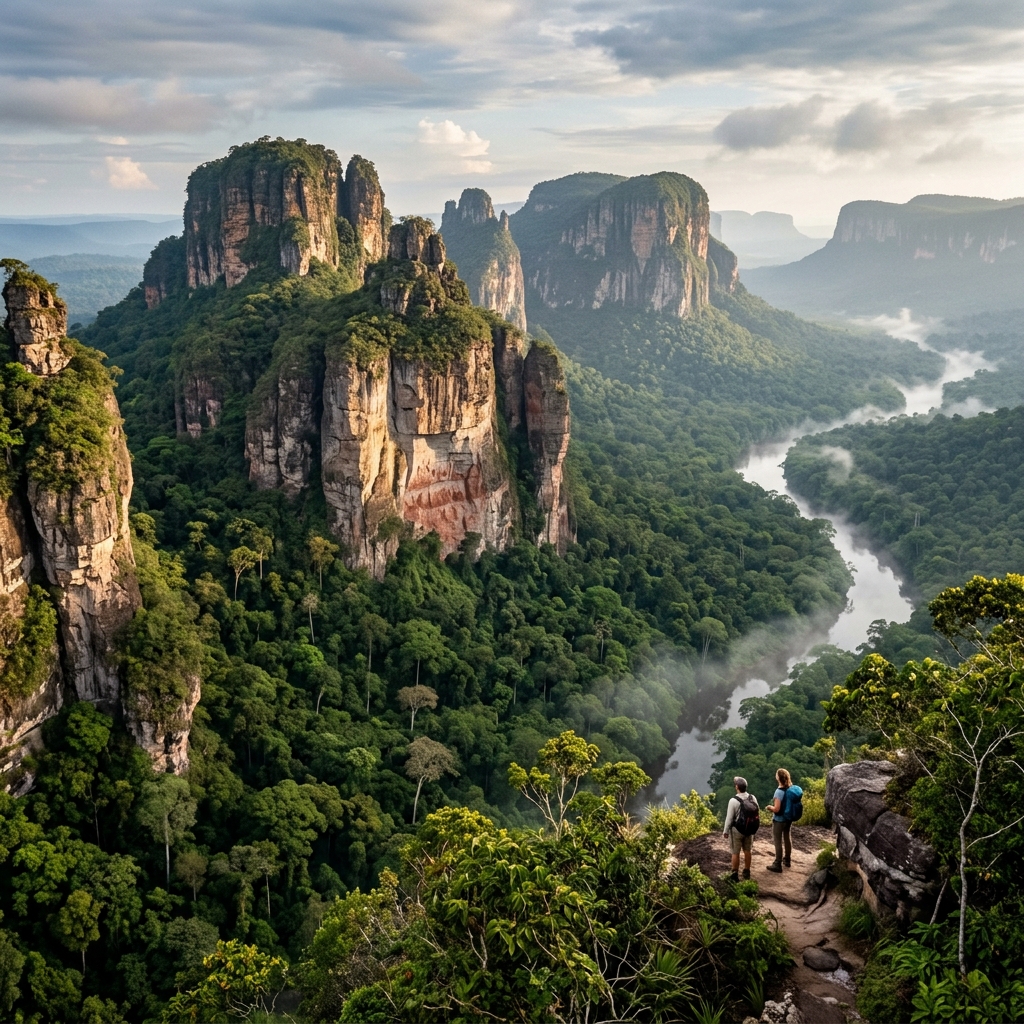
If travel is about finding the edges of the map, Chiribiquete National Park is about stepping outside of linear time. Deep within the Amazonian shield of Colombia lies a biological and archaeological marvel—a colossal protected area so vast and so rich in human history that it feels less like a destination and more like a pilgrimage. In 2026, Chiribiquete is recognized as one of the most important UNESCO World Heritage sites on the planet, protecting both a "lost world" of biodiversity and the "Sistine Chapel of the Amazon"—millions of ancient paintings on the sides of massive table-top mountains called tepuis.
This guide explores the majesty of Chiribiquete and the rigorous, respectful way to experience it in 2026.
The Tepuis: Islands in the Sky
The landscape of Chiribiquete is dominated by Tepuis—ancient, flat-topped mountains that rise vertically from the jungle floor. These formations are among the oldest rocks on Earth, dating back billions of years. In 2026, they remain largely inaccessible to humans, acting as "islands in the sky" where evolution has taken its own path. Scientists believe there are species of plants and animals on the tops of these tepuis that exist nowhere else in the world.
Flying over the park in a small plane—the only way to see the heart of the park in 2026—you will see these massive stone sentinels emerging from a sea of green that stretches to the horizon. It is a landscape that feels prehistoric, a glimpse into what the world looked like before the arrival of man. In 2026, these geological giants continue to capture the imagination of every traveler lucky enough to witness them from above.
The Rock Art: 20,000 Years of Human History
What makes Chiribiquete truly unique is the sheer scale of its human history. On the vertical walls of the tepuis, there are more than 75,000 individual paintings, some dating back more than 20,000 years. These pictographs, painted in vibrant red ochre, depict jaguars, deer, hunters, and complex geometric patterns. In 2026, they are considered one of the most significant archaeological treasures on the continent.
The art suggests a deep, spiritual relationship between the early inhabitants and the "Master of the Animals"—the jaguar. The paintings were not just decorative; they were part of a ritual cycle that has likely continued for millennia. Even in 2026, there are believed to be "uncontacted" indigenous groups living within the park who still consider these mountains as sacred territory.
Expedition Logistics: The 2026 Sustainable Approach
It is important to note that Chiribiquete is one of the most protected places on Earth. In 2026, tourism on the ground within the park is strictly prohibited to protect both the uncontacted tribes and the fragile rock art. However, you can experience the park through highly regulated Overflight Expeditions and ground-based treks in the "buffer zones" around San José del Guaviare.
- The Overflight: Departing from San José del Guaviare, specialized flights take you over the most iconic tepuis. In 2026, these flights are designed to provide maximum visibility while minimizing noise pollution.
- The Buffer Zone Trek: Sites like Cerro Azul and Nuevo Tolima, located just outside the park boundaries, offer a ground-based encounter with similar rock art and tepui landscapes. These are accessible via multi-day treks led by trained local community guides.
- Permits: All expeditions require official permits. In 2026, these are usually handled by accredited sustainable tour operators who work closely with the National Parks authority.
Biodiversity: A Living Museum of Evolution
The sheer biodiversity of Chiribiquete is in a league of its own. It acts as a monumental corridor between the Amazon, the Orinoco, and the Andes. The park is home to the Chiribiquete Emerald hummingbird, the jaguar, and thousands of species of rare orchids. In 2026, it is one of the most successful examples of large-scale conservation, where a massive area is left entirely to its own devices, allowing nature to thrive without human interference.
When you witness the park in 2026, you are looking at an ecosystem that is functioning exactly as it has for millions of years. It is a humbling reminder of the resilience of life and the importance of protecting the world's remaining wild places.
Practical Tips for the 2026 Chiribiquete Explorer
- Base in San José del Guaviare: This town is the jumping-off point for all expeditions. In 2026, it has developed into a hub for sustainable eco-tourism with high-quality lodges and expert guides.
- Book Far in Advance: Because expeditions are strictly limited to minimize environmental impact, you should book your flight or trek at least six months in advance in 2026.
- Support Conservation: A significant portion of your expedition fee in 2026 goes directly toward the monitoring and protection of the park. By choosing an ethical operator, you are a partner in its survival.
- Mindset: Approach Chiribiquete with the mindset of a guest in a sacred temple. This is not about "conquering" a destination; it's about witnessing a global miracle.
Chiribiquete is a journey that will challenge your understanding of history and your place in the world. It is an experience that reminds us that time, in the right places, moves at a majestic pace. In 2026, as you look down from the plane at the red paintings on the ancient stone, you will realize that you are looking at the very beginning of the human story in the Americas.
🕵️ Insider Secrets
- The Early Bird Overflight: Book the earliest possible morning flight. In 2026, the low morning sun hits the vertical walls of the tepuis at an angle that makes the red rock art glow with an almost supernatural intensity.
- The Mirror of the Jungle: On the treks near San José, ask your guide about Laguna Negra. It’s a mirror-like lake where you can see the reflection of the jungle canopy and the distant tepuis in total silence.
- Indigenous Knowledge: In San José del Guaviare, seek out the traditional weaving of the local indigenous communities. Their intricate designs are often directly inspired by the ancient symbols found on the rocks of Chiribiquete.
eSIM for Colombia
Avoid high roaming fees. Get instant 4G/LTE data with Airalo as soon as you land in Bogotá or Medellín.
- Instant Activation
- No Physical SIM Card
- Local & Regional Plans
Stay in Where to Stay in San José del Guaviare
Find top-rated hotels and deals. Best price guaranteed.
Explore Recommended San José del Guaviare
Discover top-rated tours and activities. Book online for peace of mind.